

Terraria’s world generation is one of the game’s fundamental systems, making each world you create different. When you create a new world, the game automatically begins generating all of its contents, such as terrain, caves, biomes, structures, resources, etc. This process is coordinated by a combination of settings you’ll configure when first starting your adventure.
Even though this process is mostly automatic, you can have more control over your world generation than you probably realise. Settings such as world size, difficulty, evil biome, and world seeds can all enhance your experience, especially special world seeds that can introduce completely new gameplay mechanics.
Understanding how your worlds are generated and what the process behind it is will surely help you decide what’s good for you when creating a brand new world, especially for multiplayer servers.
In this blog, we’ll look at what world generation is, how it works, what influences it, a few common mistakes, and how you can use different settings to create the type of world you want.
What Is World Generation?
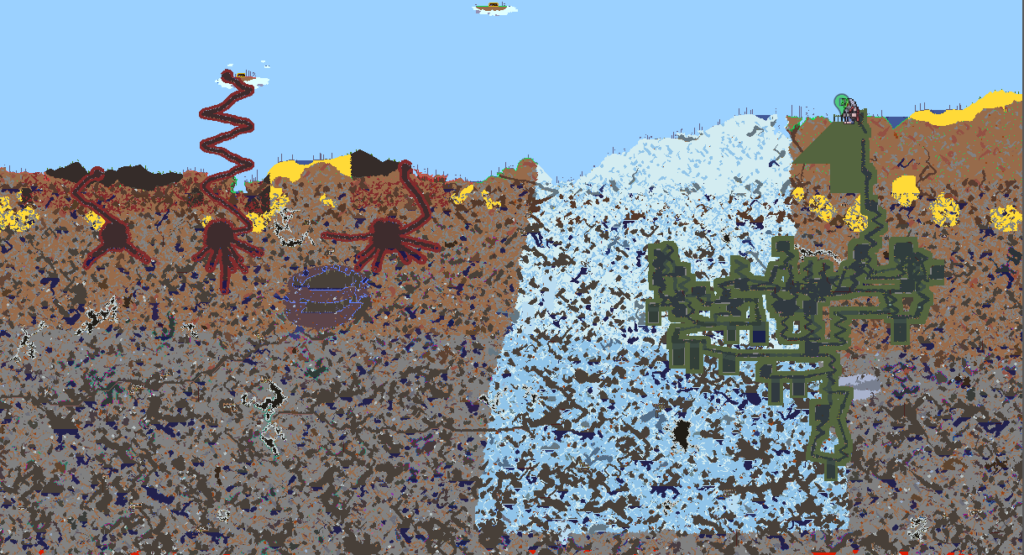
World generation is the automated process Terraria uses to build a unique two-dimensional world from scratch. This process does not simply unfold at will; it follows a strict sequence of tasks called passes to ensure all the created worlds are unique.
Instead of designing everything manually, this process handles it for you. When you create a new world, it determines its size, terrain, biome locations, underground areas, structures, and ores. This means every new world you create will give you a different experience.
Also, the game allows you to influence generation by configuring a few settings when creating your world, such as world size, game difficulty, evil biome selection, and choosing your world seeds.
The Generation Process
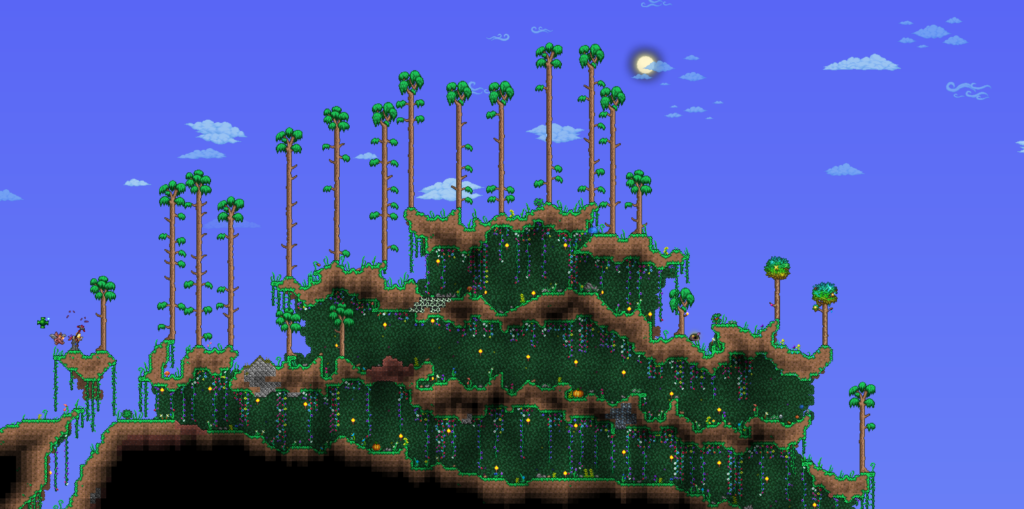
Once you’ve configured your settings and given your new world a name, the game begins generating the map.
It doesn’t simply place random blocks everywhere; it follows a strict procedural process, going through a few steps that eventually lead to the final result.
Going through the exact technical process is quite complicated, so we will have a quick look at all the major stages of the generation process to make it easier for you to understand why every world feels different than the last one.
- World Settings and Seed Are Determined: To begin, Terraria uses the world seed you’ve chosen together with the other settings you’ve selected, such as world size, evil biome, difficulty, or any other special seed features. This helps determine the basic rules that will be followed during the entire generation process.
- Creating the Foundation: The second step of the process is all about creating the base of your new world, including the surface, the underground, oceans, and hills. Being the first stage of the world means that more content and features will be added as we progress through this interesting process.
- Caves and Underground Areas: Now that the second step of the process is completed and the terrain is fully generated, the third step will take place, creating all the underground areas for you to explore. This includes caves, tunnels, ores, underground chambers, and much more. Their location and shape are different from one world to another, with each seed having a different underground layout, meaning you can’t find the same underground structures.
- Biomes and Major Structures: After that, the game starts adding some life to the world; it starts generating the well-known biomes such as the Jungle, Desert, Snow biome, Corruption/Crimson evil biomes, and Dungeon, along with some structures including Floating Islands, Living Trees, etc. Their location isn’t determined randomly; Terraria follows the generation process to determine where and how they appear in your world.
- Resources, Chests, and Points of Interest: Now that all the major features are established, Terraria starts adding content for all the players to enjoy while exploring. Content such as chests, resources, items, plants, pots, underground cabins, and other points of interest are making their way into your new world to offer you a smoother and enjoyable experience.
- Final World Setup: Now the game starts filling in the rest of the world, making sure everything in the world is working correctly, making it playable for you and your friends, and much more. Then the world is created successfully and saved in your menu so you can now play on it whenever you want and have fun.
Seed Structure Formula
You’re probably thinking how Terraria actually determines your seed number; well, it uses a structured composite string format, followed by periods to define a world seed, combining world creation parameters and a random number identifier.
A full Terraria world seed follows this layout:
[size].[difficulty].[world evil].[identifier]
- Size: To determine the world size, the game uses three different numbers: 1 for Small, 2 for Medium, and 3 for Large world size.
- Difficulty: The difficulty is chosen through four total numbers: 1 for Classic Mode, 2 for Expert Mode, 3 for Master Mode, and 4 for Journey Mode.
- World Evil: Corruption evil biome for 1, and Crimson for 2.
- Identifier: This is the final string, and the longest one too. It is the unique RNG number the game uses to generate the physical terrain, chests, and layout. This number ranges from 0 to 2,147,483,647 or negative values.
Based on this exact formula, here’s an example of a world seed:
3.3.2.148593027
To break this down, this world features a large size, along with master mode difficulty, and a Crimson evil biome. The identifier is randomly generated.
Choosing Your World Settings
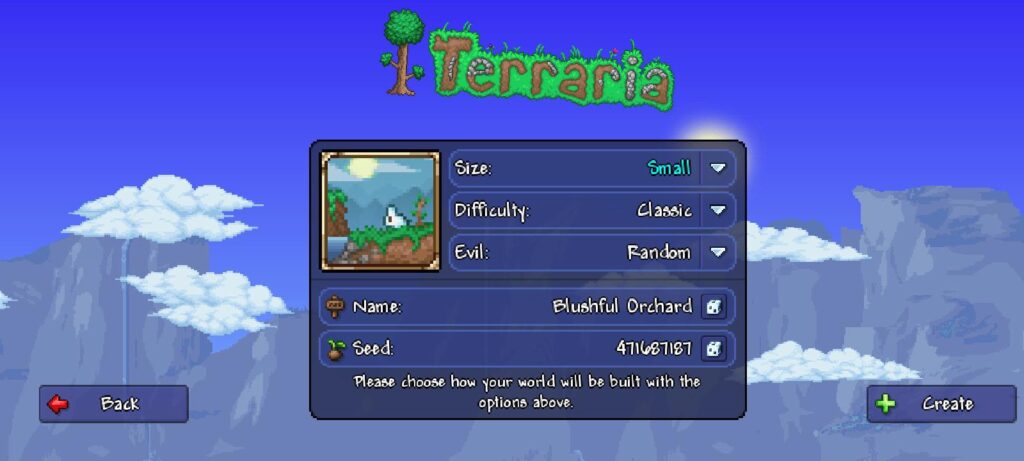
Before Terraria actually starts to generate your world, you can manually choose some settings that will change how your world will be generated. It is very important to pay attention to this aspect, especially if you’re looking for a specific type of experience in your new world.
World Size
When it comes to the size of your new world, Terraria offers three different sizes to choose from: Small, Medium, and Large. Choosing your world size should be based on what experience you’re willing to get in your new adventure.
For example, small worlds are quicker to explore, meaning you don’t need to spend many hours progressing, which leads to shorter playthroughs than the other sizes. It’s the best choice for those players who are not willing to spend that much time grinding, for solo players, or for those looking to speedrun the game.
On the other hand, medium worlds provide a balance between exploration and accessibility, offering plenty of loot with minimal exploration. Compared to small worlds, you have enough room to build several bases for you and your teammates, and enough resources for a small group made of 2-3 players. Also, you can safely enjoy deep exploration as Corruption/Crimson evil biomes don’t take over the world as quickly as they do in a small world.
As the name suggests, large worlds are the biggest world size you can choose, providing you with significantly more space for long-term progression and large multiplayer groups. You should choose this size if you’re looking to get more out of Terraria, play with a big group made of 4+ players, as it is enough loot for everyone, build huge bases, towns, and numerous farms, and generally, if you love a long journey.
The current world dimensions are approximately:
- Small World: 4.200 x 1.200 tiles
- Medium World: 6.400 x 1.800 tiles
- Large World: 8.400 x 2.400 tiles
World size will also affect how many structures and resources will be generated in your world. Meaning large worlds will have significantly more content and provide more space than a small world, although this doesn’t guarantee every structure will appear.
Talking about multiplayer servers, Medium and Large worlds are generally the best choice because several players can explore and build freely without quickly running out of space and resources.
World Difficulty
Besides your world size, you can modify your gameplay experience by choosing your desired world difficulty. You can choose your difficulty when first creating your world in the creation tab.
There is no perfect world difficulty; all of them are made for specific types of experiences. You should look for a difficulty that matches your overall skill, playstyle, or desire. These are the available options for you to choose:
- Journey
- Classic
- Expert
- Master
Now you’re probably thinking about how every difficulty affects your gameplay experience. Well, difficulty affects combat, enemy strength, gameplay mechanics, and the loot you can obtain; the greater the difficulty, the greater the reward.
Expert and Master difficulties increase the challenge compared to Classic, but also the rewards. While Journey Mode is a little different, being more like a sandbox experience, giving players greater control over their world with specific tools. Journey Mode sounds interesting at first, but is it actually worth your time? You can find out more about it in our guide, Journey Mode on a Terraria Server: Is It Worth It?.
Similar to the world size, this setting is very important for multiplayer servers because it determines the difficulty that everyone will experience.
Corruption or Crimson
Now we are going to talk about Terraria’s evil biome selection because they are also a very important aspect of your world. When creating a new world, you can let Terraria randomly choose your evil biome, or choose manually from:
- Corruption
- Crimson
Both of them serve as the world’s main evil biome, but they do have different features, like enemies, items, environments, and so on. Choosing one instead of the other can change parts of your progression and how you experience the game.
World Seeds
A world seed is essentially the input Terraria will use to determine how a world is generated, meaning that if you use the same world seed from past worlds with a similar world configuration, the resulting world will be almost identical. That’s why players often share interesting seeds with friends.
However, if you won’t manually choose a world seed, the game will automatically generate one for you, so there is no worry.
Choosing a desired seed for your new world can add some more fun to it; there are multiple choices, from normal world seeds that promise good loot to special world seeds that will modify gameplay mechanics, offering you a unique experience.
If you’re looking for interesting seeds to experience with your friends, or you want to learn more about them, check out our The Best Terraria World Seeds for Fresh Servers in 2026 guide.
Can You Control World Generation?
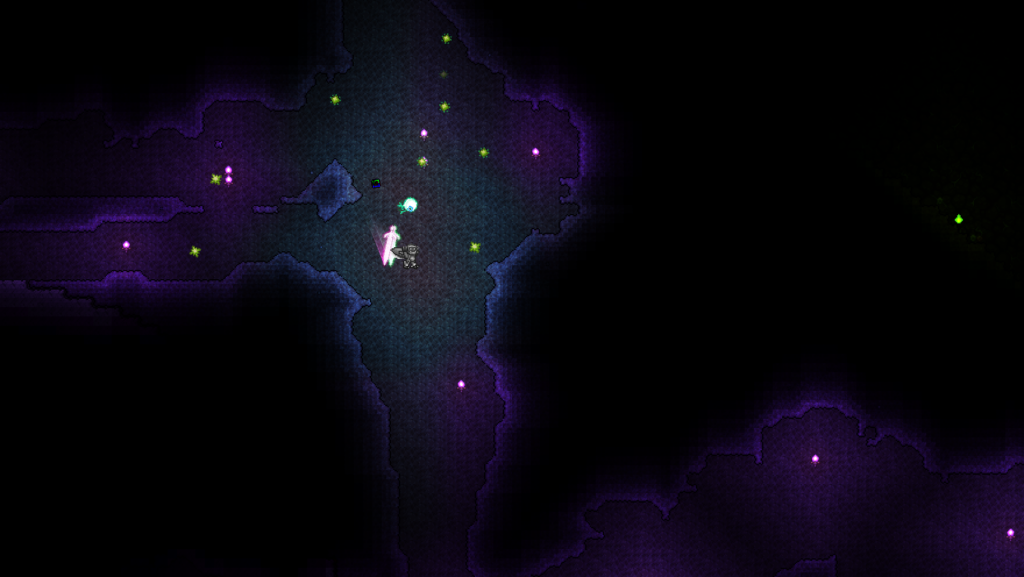
Well, you can’t actually control world generation, like manually decide where every biome, cave, or structure will appear around the world, but you can influence it through a couple of configuration options that we have already talked about:
- World Size
- World Difficulty
- Evil Biomes
- World Seeds
The world size determines how much space the game has to generate terrain, biomes, structures, and other features.
On the other hand, world difficulty will change how difficult the world is to play rather than its layout.
Choosing your desired evil biome will determine whether the world generates with Corruption or Crimson evil biomes.
Finally, the world seeds are like the blueprint for the generation process, determining how terrain, caves, and biomes are arranged.
How World Generation Affects Multiplayer Servers
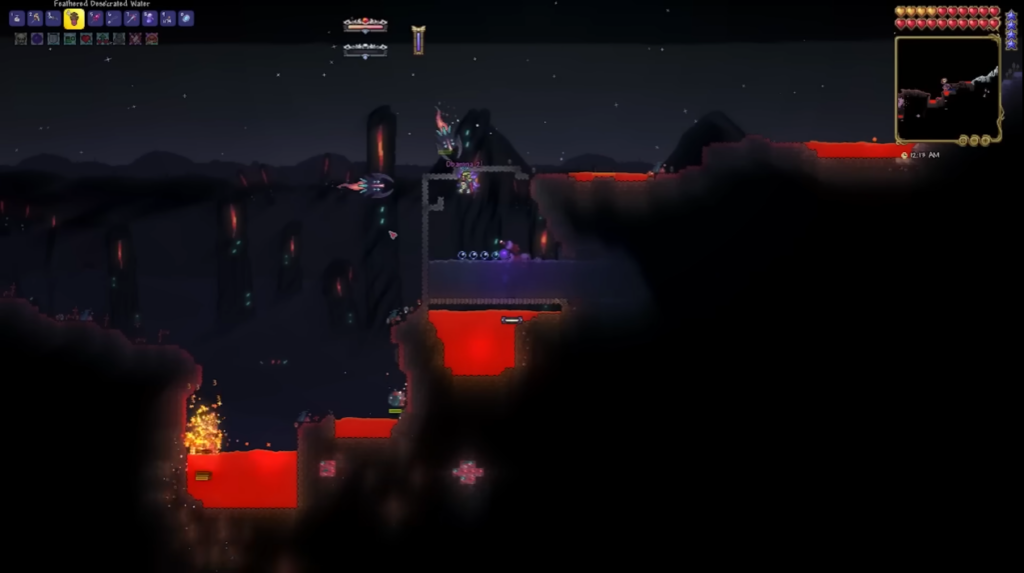
World generation becomes very important when it comes to multiplayer servers because the world you create becomes the shared environment for everyone on the server. That’s why it is recommended to reach a mutual agreement with your group regarding the world you will play in.
For example, a Small world can be the perfect size for a few players who don’t play that much, but the rest of the group may benefit from having more space to explore and build.
Your world seed choice is more important than it seems, because it can also influence the experience in a certain way. A specific normal seed can give players access to a particular world layout with more benefits from the start, while a special world seed modifies the gameplay mechanics and changes the way the server is played.
For long-term multiplayer servers, it’s worth taking some time and thinking about choosing the right world size, difficulty, evil biome, and seed before actually creating the world, because changing these later on generally means you will have to create a new world rather than modify the current one.
For a great experience on your Terraria server, it is worth looking for a reliable hosting provider. At Cybrancee, we offer advantageous Hosting Plans to fulfill your needs and expectations. Our servers are highly optimized for performance, with powerful global servers and low ping, offering DDoS protection to provide security for your server. Everything becomes easier to manage with our hosting control panel, including an AI Companion, scheduled backups, real-time server usage overview, and much more.
Become the owner of your new Terraria server, starting now at just 3.99$/month.
Common World Generation Mistakes
Well, even though this process happens automatically, there are still some mistakes players make when creating a new world to play on. It’s worth taking the time to review them to make sure you won’t repeat them.
Choosing the Wrong World Size
Creating a Small world for a large group can quickly make exploration and progress feel boring or too fast, as the world is too small. You should consult with each other and see what works best to avoid any problems regarding world size.
Ignoring the Seed
Especially if you’re looking to create a long-term server, completely ignoring the world seed means you may miss an opportunity to create a world that suits your group better from the start to the end.
Not Considering Difficulty
Being one of the most important world creation settings, meaning that the chosen difficulty affects the entire world and progression, make sure everyone playing on the server is comfortable with the chosen difficulty.
Choosing a Random Seed Without Knowing What It Does
Specifically speaking about special and secret world seeds because they can drastically change the normal Terraria experience. They can be great for experimentation, but not for long-term servers that are focused on progression and finishing the game.
Not Planning for Multiplayer
A world that’s just right for one player may not be the best for a large group later on. If you’re planning to use your server for a multiplayer experience, consider how much space everyone will use.
Summary
Terraria’s world generation process is one of the main reasons why every world you create is totally different from the last one. From the size of the world and the difficulty you will be playing on, to the location of biomes, structures, caves, and resources, all of these aspects are determined during the world generation process while following a strict sequence of passes.
World seeds give players an additional way to influence their generation process, while special and secret seeds can take this to another level by completely modifying gameplay mechanics.
For multiplayer servers, choosing the right world size, difficulty, evil biome, and seed, is essential for a smooth experience. Taking a little time to consider these settings with your group will save you a lot of time and help build a better foundation for your server.