

Factorio doesn’t ease you in. Someone opens the game meaning to build “just a small starter base,” and four hours later there’s a train network, a research queue six items deep, and someone in the group chat asking why the iron belts keep backing up again. That’s the whole appeal. It might be the one game where “just one more belt” is the entire design philosophy, and it’s exactly why a handful of friends sharing one factory can burn through an entire weekend without anyone deciding that would happen.
Running that shared factory off somebody’s gaming PC works for a while. Then the world stops advancing the second the host logs off, someone’s laptop needs to sleep before a work night, and the save file is sitting on a machine that’s one Windows update away from a very bad evening. A dedicated server fixes the obvious problem. Finding a host that actually understands how Factorio behaves under the hood is the part people get wrong.
Factorio is a strange case for hosting. It’s nowhere near as demanding as a 300-mod Minecraft pack, but it’s also not a game you can toss onto a cheap shared node and forget about. The game’s simulation rate, UPS, runs on a single CPU thread no matter how many cores the server has, and a factory that’s a few hundred hours deep will lean on that one thread hard. The five hosts below treat that seriously instead of selling Factorio as a footnote bolted onto a Minecraft-first product page.
What to Look For in a Factorio Host
The checklist here is shorter than what a modded Minecraft server demands, but a couple of items matter more than they look like they should.
The must-haves:
Strong single-thread CPU performance. Factorio’s tick doesn’t spread across cores, so clock speed and per-core performance matter more than core count. A host bragging about a 32-core server isn’t necessarily doing you any favors if each of those cores is clocked low.
Enough RAM, but don’t overpay for it. A small base for two to four people runs fine on 1 to 2GB. A sprawling megabase with mods and hundreds of hours logged wants closer to 4 to 8GB. Space Age pushed the ceiling up a bit further since the extra planets and logistics add more to track, but RAM still isn’t where most Factorio servers actually bottleneck.
Real mod support through the Factorio Mod Portal. Factorio’s mod ecosystem lives almost entirely in one place, unlike Minecraft’s three-way split between SpigotMC, Hangar, and Modrinth. That should make one-click installs simple to get right, and it’s a little disappointing how many hosts still make you upload zip files by hand.
Backups that actually restore. Factorio saves are fairly stable, but a mod update gone wrong or a version mismatch between server and client can still corrupt a save. Automatic backups with a real one-click restore option matter more than people expect until the day a base three weeks in needs one.
Save and blueprint portability. Moving a save onto a new host, or importing blueprint books from a previous world, shouldn’t be a fight with the control panel.
Nice to have:
Scenario support. Factorio ships with built-in scenarios like wave defense, and a host that surfaces those in the panel instead of burying them saves a genuinely annoying afternoon of manual config edits.
Server locations spread out, useful for a public server and mostly irrelevant for four friends in the same city.
An active Discord community, handy at midnight when a mod update breaks something, though it shouldn’t replace an actual support ticket.
| Hosting Provider | Starting Price | RAM (Entry Tier) | Best For |
|---|---|---|---|
 | $3.99/month | 2GB and up | Best overall, unlimited everything at every tier |
 | $6.00/month | 2GB and up | Fast support with a modern panel |
 | $4.99/month | 1GB, 4 slots | Cheap entry with real scenario support |
 | $3.99/month | 1GB and up | Fastest support, EX Series for megabases |
 | ~£7.50/month (~$10.09/month) | 2GB, 30 slots | UK/EU players, slot-based pricing |
1. Cybrancee
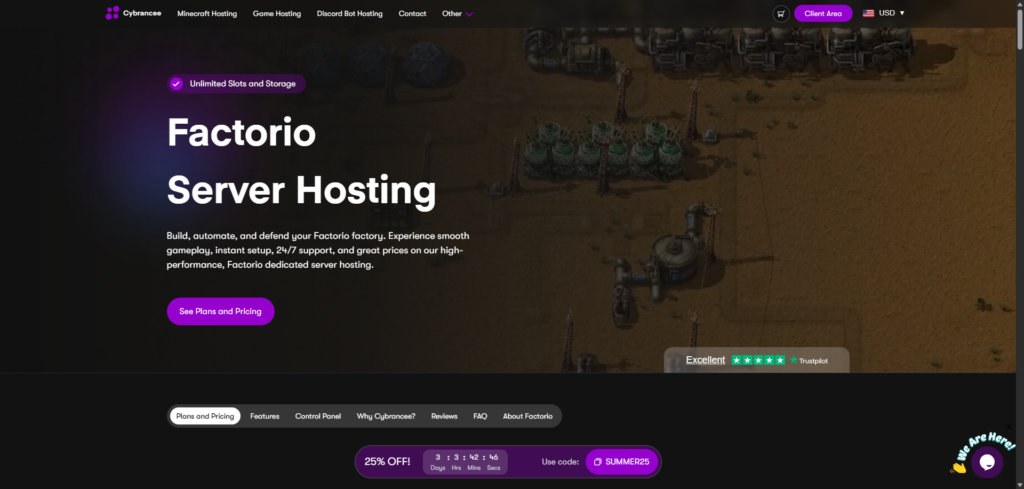
Cybrancee’s Factorio plans start at $3.99/month for 2GB, and the pitch is the same one it runs across its whole lineup: don’t make people pay more to unlock the stuff that actually matters. Every plan comes with unlimited player slots, unlimited bandwidth, and unlimited storage, which is a bigger deal for Factorio than it sounds. Long-running saves with mods and blueprint libraries eat disk space in ways a fresh world never suggests it will.
Hardware runs on Ryzen CPUs clocked above 4GHz paired with NVMe storage, which lines up with what Factorio actually needs given its single-thread dependency. Mod installs pull straight from the Factorio Mod Portal through the control panel, so setting up a quality-of-life mod or a full overhaul is a search-and-click job rather than an FTP session. The panel itself is a customized build on Pterodactyl, a step up from the aging Multicraft interface a couple of competitors on this list are still running.
Pros:
- Cheapest usable entry tier at $3.99/month for 2GB Unlimited slots, bandwidth, and storage on every plan; Ryzen CPUs above 4GHz, a real fit for Factorio’s single-thread ceiling
- One-click mod installs straight from the Factorio Mod Portal
- Scheduled automatic backups with one-click restore
- Pro-rata upgrades any time, no rebuild required
- Server locations across North America, South America, Europe, UK, Asia, Australia, and India
- 90-day money-back guarantee, 24/7 human support plus an AI assistant for quick questions
- Plants a tree for every server ordered
Cons:
- New servers ship with a soft player-slot cap for performance reasons, and raising it past the default means a quick message to support rather than a self-serve toggle
- No free trial, though the 90-day refund window covers most of what a trial would anyway
For a small group running a shared factory, or a public server that might grow into something bigger than planned, Cybrancee is the easiest recommendation on this list. The 90-day window means an actual megabase can take shape before deciding whether it was the right call, instead of guessing off a pricing page.
2. Pine Hosting
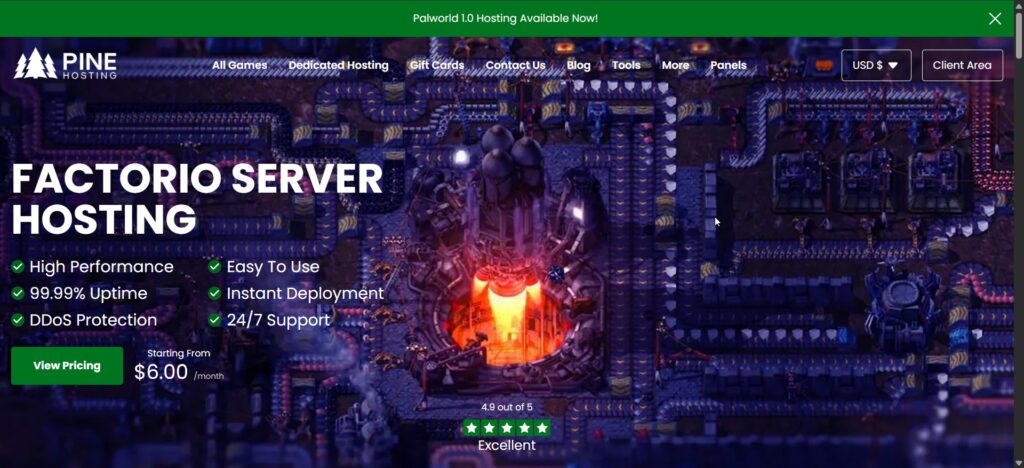
Pine Hosting started life as a UK company, and its footer copyright still traces it back to 2021, though it’s since pushed hard into the North American market too. Factorio pricing starts at $6.00 a month for a 2GB, 150% CPU “Essential” plan. A group that outgrows that can step up to a 4GB, 200% CPU “Performance” tier at $15/month, or an 8GB, 300% CPU “Extreme” tier at $30/month for a serious megabase. Pine Hosting works on a fixed scale, so a group pays for the RAM and CPU its factory actually needs instead of guessing upfront.
What stands out isn’t one flashy feature so much as how complete the panel is: a live console, per-user access controls, an automated backup manager, task scheduling, and a full file manager, all sitting on NVMe storage with DDoS protection included at no extra cost. Mods go in through the same panel, either as a zip upload into the factorio/mods folder or, where it’s supported, through mod portal syncing, and a custom map works the same way through the saves folder. Support runs 24/7 over tickets and Discord, and the company describes its team as developers and experienced server owners rather than a first-line script reader. Trustpilot backs that up with a 4.9 out of 5 rating across hundreds of reviews, with a lot of the specific praise pointing to tickets getting solved in minutes. Server locations cover California, Texas, Virginia, and Quebec in North America, the UK, Germany, and Finland in Europe, and Sydney for Asia-Pacific, and for anyone who eventually outgrows the standard tiers, there’s a separate bare-metal dedicated line running its own DDoS setup out of Texas.
Pros:
- Tiered pricing starting at $6/month for a 2GB, 150% CPU Factorio server
- Custom panel with console access, backup manager, task scheduling, and full file manager
- NVMe storage and DDoS protection included on every plan
- Mod installs through the panel, either zip upload or mod portal syncing
- 24/7 support via ticket system and Discord, backed by a 4.9/5 Trustpilot rating
- Free migration of an existing server’s files from a previous host
- Reasonable spread of data center locations across North America, Europe, and Australia
Cons:
- Only a 48-hour money-back guarantee, and it applies only to a new customer’s first order
- No free trial
Pine Hosting is worth a look for a group that cares more about a genuinely responsive support team behind a modern panel than about squeezing out every last dollar. Just decide fast if it’s not the right fit, since the refund window closes after 48 hours.
3. Shockbyte
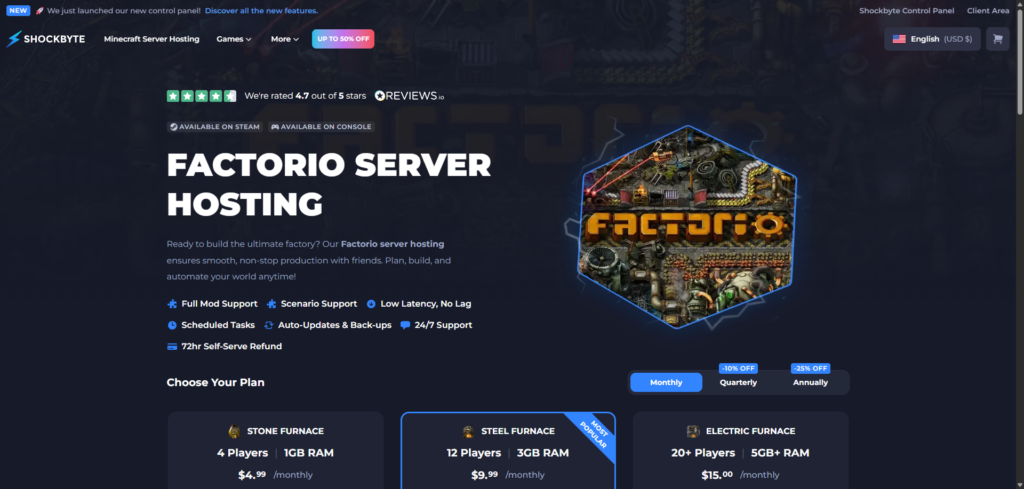
Shockbyte has built a reputation for being the cheap, reliable option, and its Factorio hosting fits that pattern. Entry pricing sits at $4.99/month for 1GB with unlimited player slots, which covers a small factory comfortably. Factorio also gets a feature most hosts treat as an afterthought: real support for the game’s built-in scenarios, including wave defense, surfaced directly in the panel instead of buried behind manual config edits.
Shockbyte has also been rolling out a new custom control panel to replace its older Multicraft-based system, with mod browsing organized by category rather than a raw file list. Hardware runs on modern AMD EPYC processors, and DDoS protection comes with an SLA covering network outages.
The honest tradeoff shows up in support speed, particularly on billing. Technical tickets move at a reasonable pace, but billing issues have been reported taking anywhere from five to twelve days to resolve. The refund window is only 72 hours, and the optional hibernation feature that sleeps an idle server has been flagged by a few users as slow to wake back up.
Pros:
- Cheap entry point at $4.99/month
- Genuine scenario support (wave defense and others) built into the panel
- New custom control panel, a real step up from the old Multicraft setup
- Modern AMD EPYC hardware DDoS protection with an SLA
Cons:
- 2GB entry RAM is fine for a starter factory but undersized for a proper late-game megabase
- Billing support response times are the slowest reported on this list, sometimes five to twelve days.
- Only a 72-hour refund window; hibernation mode can be slow to wake a server back up
Shockbyte earns its spot for anyone who wants a legitimate, no-frills Factorio server without paying a premium for it. Just don’t expect a fast turnaround if a billing question comes up.
4. Apex Hosting
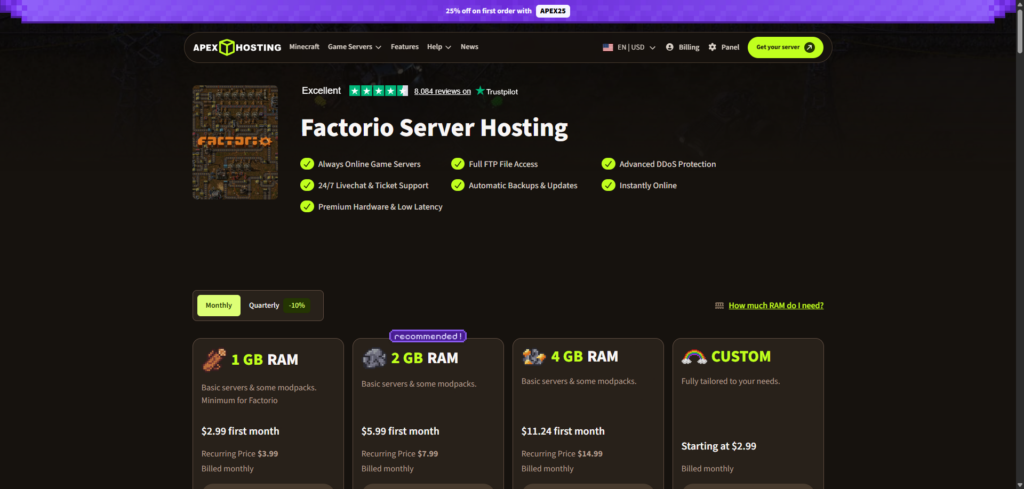
Apex’s whole pitch is speed of response, and the number backs it up: an average of around five minutes to a first ticket reply, aggressive even by industry standards. Factorio pricing starts at $2.99 for the first month, renewing at $3.99/month for 1GB with unlimited slots, climbing from there depending on RAM needs.
Where Apex actually stands out for Factorio specifically is the EX Series, a premium tier built around a Ryzen 9 5900X in the US and EU (a Ryzen 7 5800X in Asia-Pacific), 4 dedicated vCores, and clock speeds up to 4.8GHz. Since Factorio’s tick is entirely CPU-bound, that kind of dedicated clock speed is a genuinely good fit for a megabase pushing hundreds of hours, in a way it wouldn’t necessarily be for a game that spreads its load across cores. The panel handles mod installs, automatic version updates, and full FTP access, and Apex runs across 18 to 20-plus global locations.
The tradeoffs are the ones that show up across Apex’s whole lineup: the entry tier’s 1GB RAM is on the low side for the starting price, the Multicraft panel is starting to feel dated next to Cybrancee’s and Bisect’s newer interfaces, and the refund window is only 7 days.
Pros:
- Fastest average support response time on this list, around 5 minutes. EX Series offers dedicated vCores and high clock speeds, a strong match for Factorio’s single-thread ceiling
- Automatic version updates and full FTP access; 18 to 20-plus global server locations
- Daily automated backups and included DDoS protection
Cons:
- Entry tier RAM (1GB) is low for the price once the first-month discount rolls off
- Only a 7-day money-back guarantee
- The Multicraft panel is functional but showing its age next to newer competitors
If fast support matters more than shaving a couple of dollars off the monthly bill, and a megabase is in the group’s future, Apex’s EX Series is worth a look. Just don’t expect much of a trial period if it’s not the right fit.
5. GTX Gaming
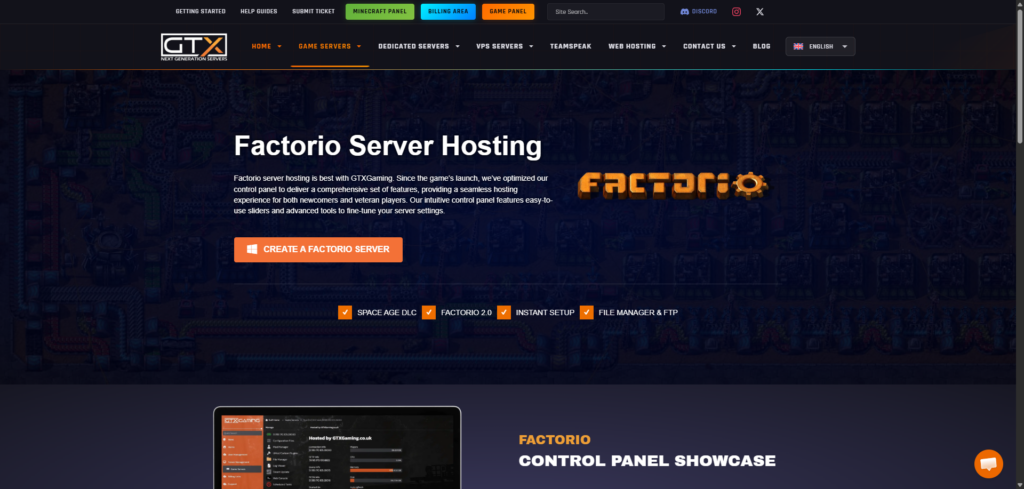
GTX Gaming has built a strong following in the UK and European market, and its Factorio pricing reflects a different philosophy than the rest of this list: plans are priced per player slot and per GB of RAM rather than around flat tiers, working out to roughly £1.90 per GB (about $2.40). A 2GB plan supporting 30 players runs around £7.50 to £7.80/month.
Entry-tier hardware runs on Intel i7 processors clocked around 4.2GHz, with higher tiers stepping up to Ryzen 9 hardware for bigger factories. The panel setup leans on sliders and drop-down menus rather than a single unified dashboard, which makes configuration approachable for newcomers while still leaving full FTP access and manual text-editor control for people who want it. Security gets more attention here than most competitors bother with: SSL and md5 encryption plus two-factor authentication across accounts.
The catch is the refund window. It’s 24 hours, the tightest on this list by a wide margin, and the per-slot pricing model takes a minute to compare directly against the RAM-based plans everyone else on this list is running.
Pros:
- Slot-based pricing that suits players who care more about max headcount than raw
- RAM 28 global data center locations Sliders and drop-down menus make configuration approachable
- Two-factor authentication and encryption across accounts
- One-click mod installs
- Strong Trustpilot reputation around 4.6 to 4.7 out of 5
Cons:
- Just a 24-hour money-back guarantee, the shortest window on this list
- Pricing in GBP is a minor hassle to track for non-UK/EU customers
- Entry-tier CPUs (i7, 4.2GHz) sit a step behind the Ryzen hardware on the higher tiers
- Per-slot billing makes direct price comparisons more work than it should be
If the player base is mostly European, or slot count matters more than squeezing out extra RAM, GTX covers ground the rest of this list doesn’t. Just decide quickly, since there’s no real trial period to fall back on.
Understanding Factorio’s Performance Model: Why RAM Isn’t the Bottleneck
Factorio measures its own performance in UPS, updates per second, rather than FPS. Sixty UPS is the target, and the whole simulation belts, trains, biters, circuit networks runs as one deterministic tick that has to finish before the next one starts. That tick is single-threaded no matter how many cores the server has, which is the main reason clock speed and per-core performance matter more here than they do for most other game servers. A host that leans on core count instead of clock speed is optimizing for the wrong number.
RAM matters, but less than most people assume going in. A small base for a handful of friends barely touches 1 to 2GB. It’s map size, mod count, and how long a save has been running that push RAM usage up, not player count on its own. Space Age raised the ceiling a bit by adding more planets and logistics to track, but a server bottlenecking on RAM alone is rarer than one bottlenecking on CPU.
Mods come almost entirely from one source: the official Factorio Mod Portal. That’s simpler than Minecraft’s three-way split across SpigotMC, Hangar, and Modrinth, though it also means a host’s one-click installer either handles the portal well or it doesn’t, since there’s no second source to fall back on. Blueprint books and save files are portable between hosts as long as the destination server is running a compatible Factorio version, which is worth double-checking before a migration rather than after.
Conclusion
Cybrancee tops this list because it doesn’t gate the basics behind a pricier tier. A usable 2GB plan at $3.99/month, unlimited slots and storage from the start, and a 90-day window to actually run a factory through its awkward early stages puts it ahead for most people setting up a shared world.
The other four earn their spots for narrower reasons. Pine hosting is worth it if you want a modern panel to work with and get fast support when you need it the most. Shockbyte is the pick for anyone who wants real scenario support without paying a premium, as long as billing tickets aren’t urgent. Apex makes sense if fast support and dedicated CPU clock speed for a megabase matter more than shaving a few dollars a month. GTX Gaming is the strongest option for European players or anyone who’d rather pay by slot count than by RAM tier, as long as the 24-hour refund window doesn’t get in the way of deciding.
Factorio is more forgiving on hardware than a heavy modpack, but the CPU-bound tick means the gap between a host that gets that and one that doesn’t shows up eventually, usually right around the point the factory stops being small. Check what a specific save actually needs before buying, not just what the plan page claims is enough.
Happy automating!
If you think your business should be on our list, contact us.