

Minecraft doesn’t need mods to eat up your evenings. Give four friends a flat survival world, a decent economy plugin, and a shared goal like “finish the mob farm before the weekend,” and you’ll lose just as many hours as any modpack ever managed. That’s the version of Minecraft most people actually play, and it’s still the biggest one on the planet by player count.
Running that world off your own PC works for about a week. Then someone’s asleep when everyone else wants to play, your router hiccups mid-build, and the world folder is sitting on a laptop that’s one bad update away from disaster. A dedicated host fixes the obvious problems. It’s picking the right one that trips people up.
Vanilla and lightly-plugged servers are forgiving compared to a 300-mod pack, but “forgiving” isn’t the same as “doesn’t matter.” A host running your server on an overcrowded shared node will still lag the moment fifteen players are online, and someone triggers a redstone farm. The five hosts below actually treat plain Minecraft as a product worth getting right, not just a checkbox next to “supports 100 games.”
What to Look For in a Minecraft Host
The list here is shorter than what modded hosting demands, but a couple of items matter more than people expect.
The must-haves:
Real server software support. Vanilla is fine for four friends, but the moment you want plugins, you need Spigot, Paper, or Purpur, and you need to be able to switch between them without opening a ticket. Paper in particular has become the default for a reason: it’s a performance-focused fork of Spigot that most plugin developers build and test against first.
Enough RAM without overpaying for it. A small survival world for two to four people runs comfortably on 1 to 2GB. A public server running EssentialsX, a land-claim plugin, an economy, and a couple of minigames wants closer to 4GB. Anyone selling you 8GB minimum for a plugin server that isn’t running a mob-battle arena plugin is upselling, not helping.
Easy plugin installation. SpigotMC and PaperMC’s Hangar cover most of what people actually run, and a host that lets you search and install from inside the panel saves a genuinely annoying afternoon of manual jar uploads.
Fast Minecraft version switching. Plugins lag behind new Minecraft versions all the time, and a host that makes you file a ticket to roll back from 1.21 to 1.20.4 while you wait for a plugin update is going to cost you a weekend.
Backups that restore cleanly. Worlds get corrupted less often than modded ones, but it still happens, usually right after someone updates a plugin without checking changelogs first. Automatic backups with an actual one-click restore matter more than people think until the day they need one.
Nice to have:
Server locations spread across the map, which matters a lot for a public server and barely at all for four friends in the same city.
An active Discord community, handy for plugin conflicts at midnight, though it shouldn’t be a substitute for actual support tickets.
Pricing Comparison
| Hosting Provider | Starting Price | RAM (Entry Tier) | Best For |
|---|---|---|---|
 | $1.99/month | 1GB and up | Best overall, cheapest tier that isn’t crippled |
 | $2.99/month | 2GB and up | Widest game library if you rotate titles |
 | $3.99/month | 1GB, 10 slots | Long-time Minecraft specialist, deep plugin catalog |
 | $5.99/month | 2GB and up | Fastest support response times |
 | £1.90/GB (~$2.40) | 2GB and up | UK/EU players, hybrid plugin+mod setups |
1. Cybrancee
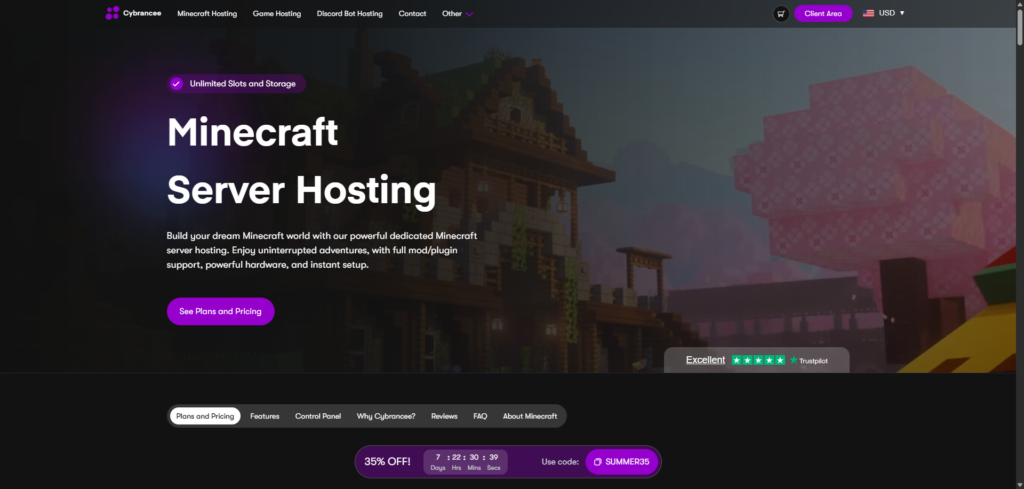
Cybrancee’s pitch for plain Minecraft is basically the same as its pitch for modded: don’t make people pay extra to get the features that actually matter. The $1.99/month tier gets you 1GB, which is genuinely usable for a small survival world, and every plan above that comes with unlimited player slots, unlimited bandwidth, and unlimited storage. A lot of budget hosts cap slots on their cheapest tier and expect you to upgrade the moment a sixth friend wants in. Cybrancee doesn’t bother with that.
Paper, Spigot, Purpur, and vanilla are all supported and switchable from the panel, and the built-in Minecraft version selector means rolling back or jumping forward doesn’t involve waiting on a support queue. Plugin installation pulls from SpigotMC and Hangar directly, so setting up EssentialsX, a permissions plugin, and an anti-cheat is a search-and-click job. The panel itself is a customized Pterodactyl build, which is a step up from the aging Multicraft interface some competitors are still running.
Pros:
- Usable 1GB tier at $1.99/month, not a stripped-down teaser plan
- Unlimited slots, bandwidth, and storage on every plan
- Paper, Spigot, Purpur, and vanilla, switchable without a ticket
- One-click plugin installs from SpigotMC and Hangar
- Ryzen CPUs clocked over 4GHz, NVMe storage
- Scheduled automatic backups with one-click restore
- Server locations across North America, Europe, UK, Asia, Australia, and India
- 90-day money-back guarantee
- 24/7 human support plus an AI assistant for quick questions
- Plants a tree for every server ordered
Cons:
- No free trial, though the 90-day refund window covers most of what a trial would
- The number of RAM tiers takes a minute to sort through the first time, though the built-in calculator handles most of the guesswork
For a plain survival world, a small plugin server, or a public community that might grow past what you planned for, Cybrancee is the easiest recommendation here. The 90-day window means you can actually run the server for a couple of months with a real player base before deciding it’s the right fit, rather than guessing off a product page.
2. BisectHosting
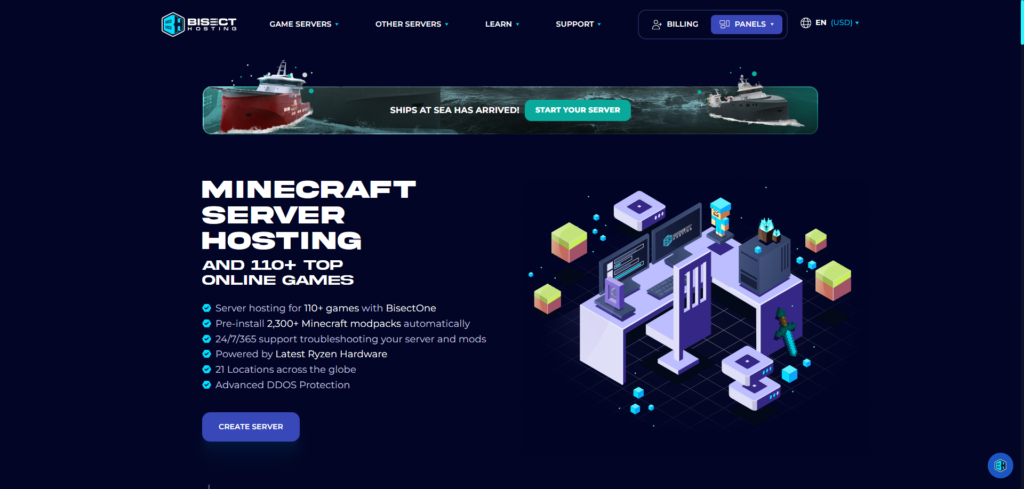
Bisect has been in this space since 2011, and its Minecraft-specific tooling shows the age in a good way. For plain Minecraft, the Budget tier is actually a reasonable starting point, unlike on the modded side where it’s genuinely underpowered. A 2GB Budget plan runs about $2.99/month and handles a small Paper server without issue.
Where Bisect pulls ahead of most hosts is its game library. Starbase, its custom panel, includes an Instance Manager that lets you run several server setups on one account and swap between them, so if your group decides to try Palworld or Valheim for a month, you’re not canceling and re-ordering anything. MariaDB and MySQL support out of the box also matters if you’re running an economy plugin that wants a real database instead of flat files.
Pros:
- Budget tier is actually viable for plain plugin servers
- Instance Manager for running multiple server setups on one account
- MariaDB/MySQL support built in
- 21 global server locations
- Average support response under 15 minutes
- Free DDoS protection on every plan
Cons:
- Per-GB pricing climbs faster than Cybrancee’s flat tiers once a server grows past a handful of players
- Only a 3-day money-back guarantee, a fraction of Cybrancee’s 90 days
- Promotional first-month pricing renews higher, worth checking before committing long-term
If your group likes to hop between games or wants a real database backing an economy plugin, Bisect’s tooling is genuinely useful. Just keep an eye on the renewal price and the short refund window before locking in.
3. Shockbyte
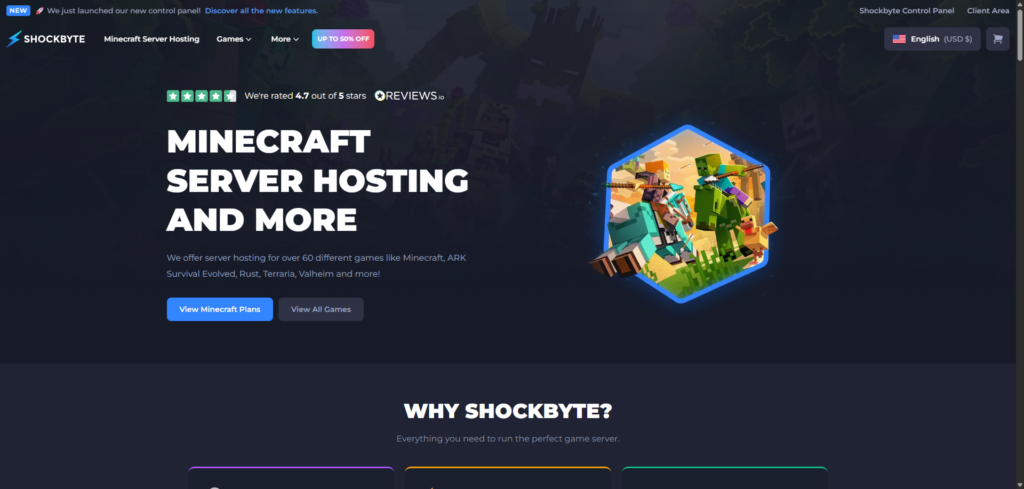
Shockbyte has built its entire reputation on plain Minecraft since 2013, and it shows. The plugin catalog through SpigotMC covers essentially everything a plugin server would want, and the newer custom control panel replacing the old Multicraft setup is a real improvement, with modpack and plugin browsing organized by category instead of a raw file list.
The “Dirt” tier at $3.99/month for 1GB and 10 slots is aimed at exactly the audience this article is for: a small group running vanilla or a lightly plugged survival world. Hardware runs on modern AMD EPYC processors, a step up from the aging boxes some budget hosts are still running plain Minecraft on.
The honest tradeoff is support speed, particularly on billing. Technical tickets move reasonably fast, but billing issues have been reported taking anywhere from five to twelve days to resolve. The refund window sits at 3 days, and the optional hibernation feature, which sleeps an idle server, has been flagged by a few users as slow to wake back up.
Pros:
- Deep, Minecraft-specific plugin support through SpigotMC
- New custom control panel is a real step up from the old Multicraft interface
- Modern AMD EPYC and Intel Xeon hardware
- Free DDoS protection with an SLA covering network outages
Cons:
- Billing support response times are the slowest reported on this list, sometimes five to twelve days
- Only a 72-hour refund window
- Hibernation mode can be slow waking a server back up after it’s gone idle
Shockbyte earns its spot as a Minecraft specialist that knows the game well. Just budget extra patience if a billing question comes up, and don’t count on the refund window if you need more than a couple of days to test things.
4. Apex Hosting
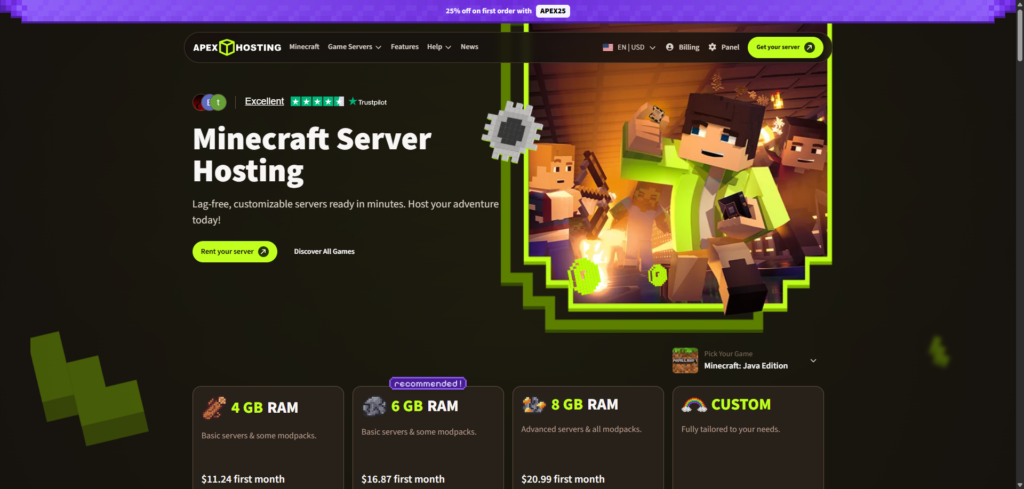
Apex’s whole selling point is speed of response, and the number backs it up: an average of around five minutes to a first ticket reply, which is aggressive even by industry standards. For plain Minecraft, entry pricing starts around $5.99/month for 2GB, climbing from there depending on slot count and RAM.
Paper, Spigot, and vanilla are all supported with one-click plugin installs, and the panel includes guided setup tutorials that are genuinely useful for a first-time server owner who’s never touched FTP or a config file. Apex runs across 18 to 20-plus global locations, so a spread-out player base shouldn’t be the reason to skip it.
The Multicraft panel itself is the one place Apex is starting to feel dated next to Cybrancee’s and Bisect’s newer interfaces. And while the support speed is real, the entry pricing runs a bit higher than most budget competitors for comparable RAM, and the refund window is only 7 days.
Pros:
- Fastest average support response time on this list
- Guided setup tutorials for first-time server owners
- 18 to 20-plus global server locations
- Daily automated backups and included DDoS protection
Cons:
- Entry pricing runs higher than most budget-tier competitors for comparable RAM
- Only a 7-day money-back guarantee, well short of Cybrancee’s 90 days
- The Multicraft panel is functional but starting to show its age
If fast support matters more to you than shaving a couple of dollars off the monthly bill, Apex is a solid pick. Just don’t expect much runway if you decide it’s not for you.
5. GTX Gaming
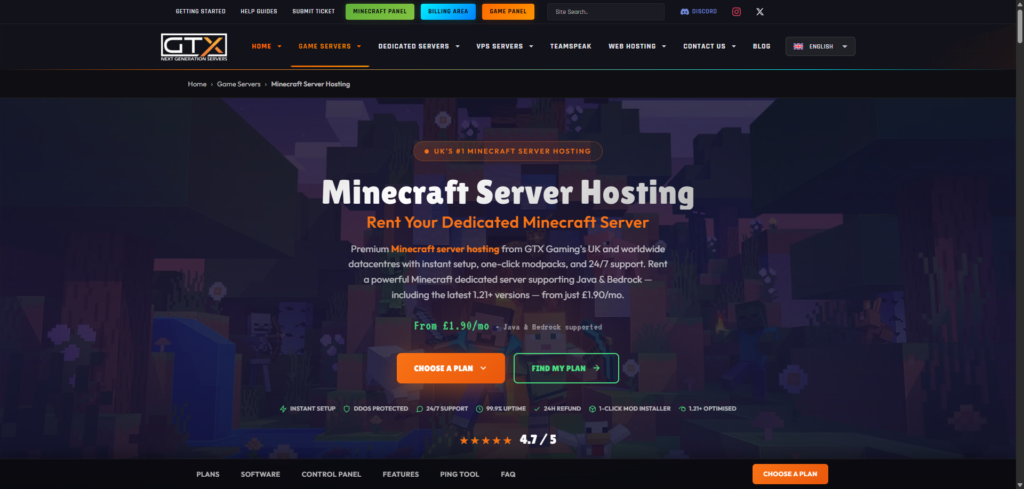
GTX Gaming has been around since 2007, and it’s built a strong following specifically in the UK and European market. Minecraft plans are priced per GB starting around £1.90/GB (roughly $2.40), with a 2GB plan running about £3.20/month, enough for a small survival server with light plugins.
What sets GTX apart is how many server types it handles without treating any as an afterthought: vanilla, Spigot, Paper, and hybrid platforms like Mohist that let you run Forge mods and Bukkit-style plugins side by side, useful if your “plain” server ends up wanting one or two light mods alongside the usual plugins. One-click installs pull from SpigotMC and Modrinth through the panel.
The panel setup is more fragmented than some competitors, splitting general management, Java-specific controls, and plugin browsing across three separate tools rather than one unified dashboard. Trustpilot reflects a strong reputation, at 4.7 out of 5 across more than 1,400 reviews.
Pros:
- Handles vanilla, Spigot, Paper, and hybrid setups cleanly
- One-click installs from SpigotMC and Modrinth
- 28 global data center locations
- Strong Trustpilot reputation at 4.7/5 across 1,400-plus reviews
Cons:
- Just a 24-hour money-back guarantee, the tightest window on this list
- Pricing in GBP is a minor hassle for non-UK/EU customers tracking costs elsewhere
- Panel setup spans three separate tools rather than one unified interface
If your player base is mostly in Europe or you want a light hybrid setup without a dedicated modded plan, GTX covers ground the others don’t. Just make your decision quickly, because there’s no long trial period to fall back on.
Vanilla vs. Spigot vs. Paper vs. Purpur
If you’re new to Minecraft hosting, the server software options get confusing fast, so here’s the short version.
Vanilla is the unmodified game straight from Mojang. No plugins, no performance tweaks, just the game as it ships. Fine for a small friend group that doesn’t want anything extra.
Spigot is the plugin-enabling fork that’s been around the longest and still has the biggest plugin library. Most plugin developers started here, even if they’ve since moved on.
Paper is a performance-focused fork of Spigot and has become the default choice for most plugin servers. It’s compatible with the vast majority of Spigot plugins while running noticeably better under load, especially with more players online.
Purpur forks Paper again and adds extra configuration options and gameplay tweaks, mostly appealing to server owners who want fine-grained control over things like mob behavior or block mechanics without installing a plugin for it.
As for where plugins actually come from: SpigotMC has the largest and oldest library, and PaperMC’s Hangar has grown into a solid alternative with better version tagging for compatibility. Modrinth, better known for mod hosting, has also started picking up plugin listings. A host that only pulls from SpigotMC covers most needs, but it’s worth checking if a specific plugin you want lives on Hangar or Modrinth instead.
Conclusion
Cybrancee tops this list because it doesn’t gate the basics behind a pricier tier. A usable 1GB plan at $1.99/month, unlimited slots and bandwidth from the start, and a 90-day window to actually test the server puts it ahead for most people running a plain survival world or a small plugin server.
The other four earn their spots for narrower reasons. Bisect is worth it if you want to run multiple server setups or games from one account. Shockbyte is the pick if you want a host that’s spent over a decade focused specifically on Minecraft and don’t mind the occasional slow billing response. Apex makes sense if fast support matters more than shaving a few dollars a month. GTX Gaming is the strongest option for European players or anyone who wants a light hybrid plugin-and-mod setup, as long as you decide fast given the 24-hour refund window.
Plain Minecraft is more forgiving than a modpack, but a host that treats it as a real product instead of a checkbox still makes a noticeable difference the moment your server actually has people on it. Check what RAM your group actually needs before you buy, not just what the plan page tells you is enough.
Happy building!
If you think your business should be on our list, contact us.