
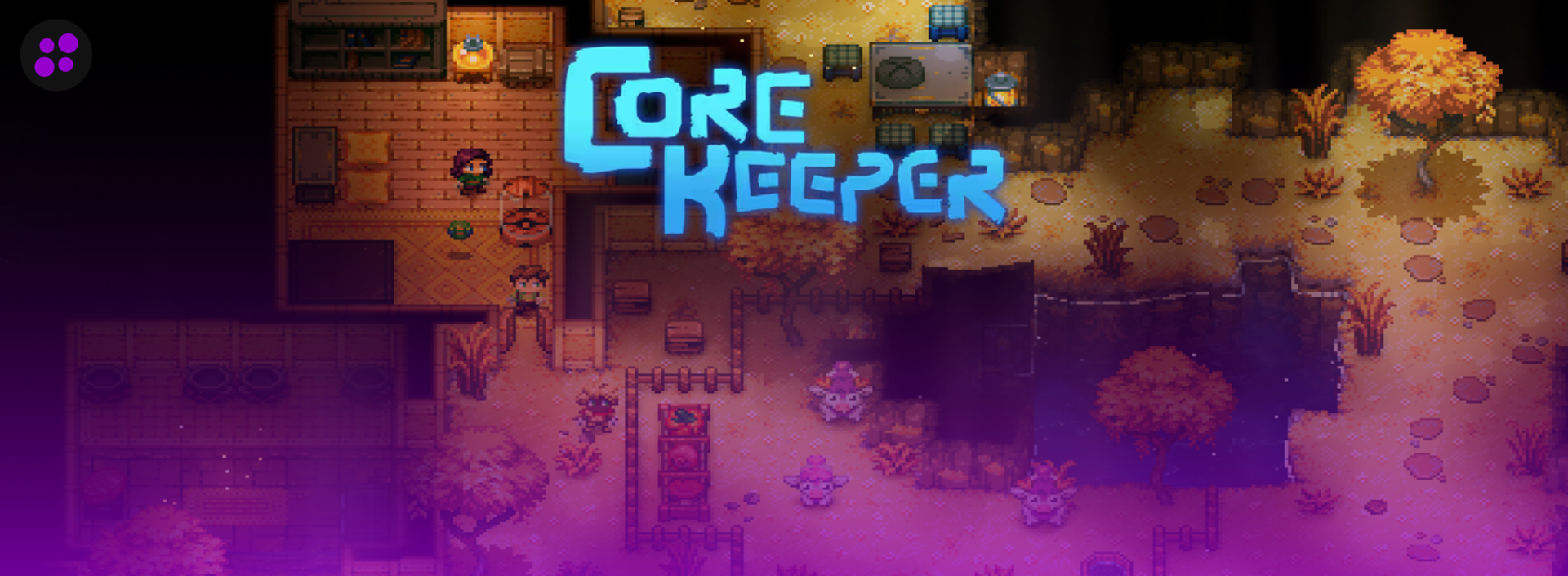

Core Keeper starts small. One person, one pickaxe, one glowing wall of dirt. Give it a weekend with friends, and it turns into something else entirely: a base with conveyor belts and auto-farms, a rotating cast of people dropping in and out, and a running argument about who’s actually ready for the next boss. It’s one of the few survival games where the multiplayer isn’t a bolt-on feature; it’s the whole reason the game works the way it does. Pugstorm built it that way on purpose, and it shows.
The problem is the same one every co-op sandbox runs into eventually. Someone hosts the world from their own PC, and the moment they log off or their internet hiccups, everyone else is locked out. Core Keeper does at least ship an official dedicated server tool through Steam, which puts it ahead of games that leave this to the community, but running that tool off a spare laptop just moves the problem instead of solving it. A proper host fixes it for good, assuming you pick one that actually treats the game seriously instead of listing it as one more checkbox next to five hundred other titles.
Here are the five hosts that got Core Keeper right in 2026.
What to Look For in a Core Keeper Host
Core Keeper is a light game to run compared to something like Enshrouded, but a couple of details catch people off guard if they don’t know to check for them first.
The must-haves:
RAM that grows with the world, not just the player count. Core Keeper caches every area your group has explored, and that cache doesn’t shrink back down when people log off. A brand-new world with two players runs fine on 2 to 4GB. A world that’s been mined for a few weeks, with six people digging in different directions, wants more headroom than that. Check whether a host’s entry tier is sized for a fresh start or built to still work three months in.
A panel that handles the game’s Linux quirk automatically. The dedicated server needs a virtual framebuffer to run headless on Linux, since it still relies on OpenGL for world generation even without a display attached. Managed hosts deal with this behind the scenes. If you’re comparing a host against self-hosting on a VPS, this is one of the things that quietly eats an evening if nobody warns you about it first.
Support for a full lobby. Core Keeper officially supports up to 8 players in drop-in, drop-out co-op, and there’s no hard cap beyond that if a host lets you push past it. Performance does start to slip past 8 to 10 without decent CPU and RAM behind it, so if your group runs bigger than the usual four to six friends, check what a plan actually handles rather than trusting the word “unlimited” on its own.
Backups that hold up through patches. Core Keeper still ships regular updates, and past patches have changed world generation or broken things that were working in the update before. Automatic, frequent backups with a real restore option matter more here than the marketing copy usually lets on.
DDoS protection included, not upsold. A public or semi-public server is a target the moment it’s up around the clock. This should be baked into the base price.
Nice to have, though not essential for a small friend group: server locations spread out if your players aren’t all in the same region, and an active community for troubleshooting the occasional mod conflict, since Core Keeper’s modding scene is community-built rather than officially supported by Pugstorm.
Pricing Comparison
| Hosting Provider | Starting Price | RAM | Best For |
|---|---|---|---|
 | $3.99/month | 2GB and up | Best overall, cheapest tier that isn’t stripped down |
 | $8.99/month | 3GB and up | Groups who want an easy, guided setup |
 | $6.99/month | 2GB, 8 slots | Small groups on a tight budget |
 | ~$6.35/month | 2GB and up | Players who want to hand-pick every spec |
 | ~£5.70 (~$7.30)/month | 5GB and up | UK/EU players who want premium hardware |
1. Cybrancee
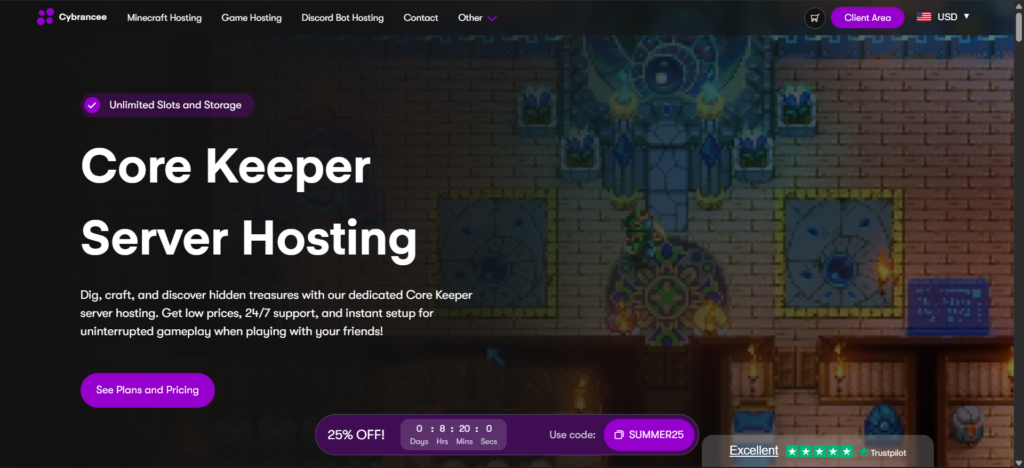
Price: Plans start at $3.99/month for the 2GB Scarlet tier, then $6.99 for 4GB (Galaxite), $9.99 for 6GB (Ultimate), and $14.99 on the Scalable tier for up to 32GB.
Cybrancee earns the top spot the same way it does on most of these lists: the cheap tier isn’t a stripped-down teaser. Even the $3.99 plan comes with unlimited player slots, unlimited storage, full mod and FTP support, and hardware running Ryzen CPUs clocked past 4GHz with NVMe storage underneath. Setup is instant, the proprietary panel doesn’t need a manual to figure out, and server locations span North America, South America, Europe, Asia, Canada, and Australia.
The 90-day money-back guarantee is the real standout. Most hosts on this list give you three days to decide whether a server works for your group. Cybrancee gives you three months, which is enough time to actually mine through a world with friends before committing.
Pros:
- Cheapest usable entry tier on this list
- Unlimited slots, storage, and bandwidth on every plan
- Ryzen CPUs at 4GHz+, NVMe SSDs
- Full mod and FTP support out of the box
- Server locations across six regions
- 90-day money-back guarantee
- Active Discord community and 24/7 human support
Cons:
- No free trial, though the 90-day window covers most of what a trial would
Cybrancee is the easiest recommendation here for a small group or a growing public world alike. The refund window alone removes most of the risk of trying it.
2. BisectHosting
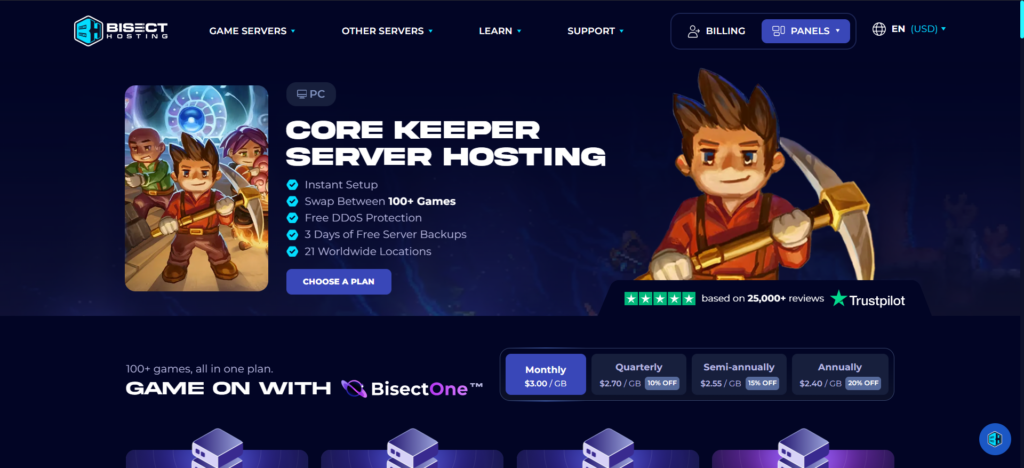
Price: The BisectOne plan starts around $8.99/month for 3GB and scales up per gigabyte from there depending on what your group needs.
Bisect has been running game servers since 2011, and its Starbase panel shows that experience. The Instance Manager lets you run more than one server setup from a single account, useful if your group ever wants to try a different game for a week without canceling and re-ordering anything. MariaDB and MySQL support is built in too, which matters more once a server grows past a handful of casual players.
Support is a genuine strength: average ticket response sits under 15 minutes, and every plan includes free DDoS protection alongside 3 days of automated backups.
Pros:
- Instance Manager for running multiple server setups on one account
- MariaDB/MySQL support included
- 21 worldwide server locations
- Average support response under 15 minutes
- Free DDoS protection on every plan
Cons:
- Per-GB pricing climbs faster than Cybrancee’s flat tiers as a server grows
- Only a 3-day money-back guarantee
- Billing and panel logins are separate, which trips up some first-time users
- Promotional first-month pricing tends to renew higher
If your group likes switching between games or wants real database support behind an economy or trading system, Bisect’s tooling justifies the higher entry price. Just keep an eye on the renewal cost.
3. Shockbyte
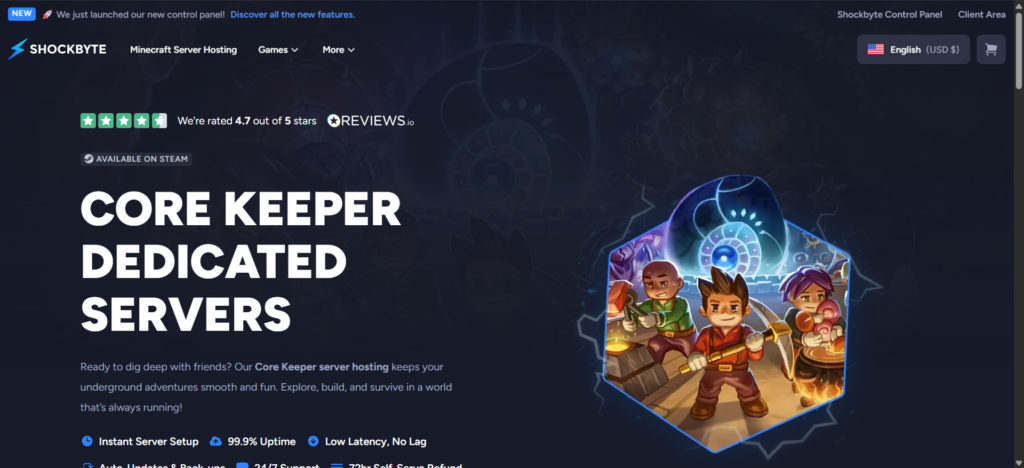
Price: The Metropolis plan runs $6.99/month for 2GB and 8 player slots.
Shockbyte built its name on Minecraft hosting starting in 2013, and that same infrastructure carries over reasonably well to Core Keeper. The newer Shockbyte control panel replaced an aging Multicraft setup, hardware runs on modern AMD EPYC processors, and every plan includes enterprise-grade DDoS protection with 99.9% uptime and automated backups.
The catch is RAM sizing. Core Keeper’s memory needs grow with world exploration, and a plan sized for a fresh start can feel tight a few weeks in. It’s worth sizing up rather than assuming the entry tier will scale with a world that keeps getting bigger. Billing support is also the slower part of the experience here, with response times on billing tickets sometimes stretching five to twelve days, and the refund window is a short 72 hours.
Pros:
- Modern AMD EPYC hardware, NVMe SSD storage
- New, easier-to-navigate control panel
- Enterprise DDoS protection with an uptime SLA
- Automated backups included
- Long track record with a large, active community
Cons:
- Entry-tier RAM can get tight as a world grows
- Billing tickets have been reported taking five to twelve days
- Only a 72-hour refund window
Shockbyte suits a small group that just wants a straightforward, budget-friendly start, as long as you size the RAM for where the world will be in a month, not just where it is on day one.
4. ZAP Hosting
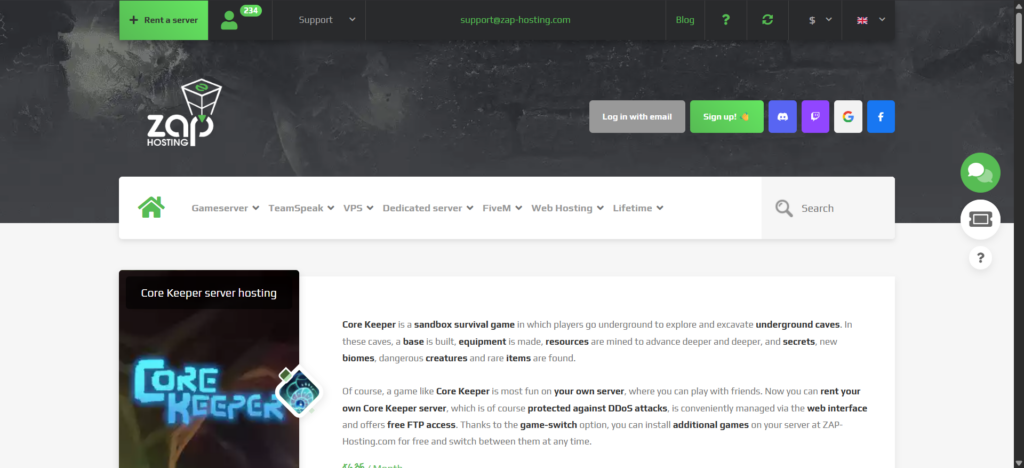
Price: Base configurations start around $6.35/month, with RAM, CPU cores, and slot count all adjustable from there.
ZAP-Hosting skips the fixed-tier model most hosts use and lets you build a plan piece by piece instead. Hardware runs on Intel Xeon E5-2650v4 processors with DDR4 memory on hosts scaling up to 328GB, paired with SSD storage. Locations lean heavily European, covering Germany, France, and the UK, alongside North America, Asia, and Australia. Free FTP access, free DDoS protection, and daily backups come standard, and the whole thing runs through a web-based ZAP Panel rather than a third-party interface.
That level of control is the appeal and the drawback in the same breath. Someone who wants to dial in exact CPU and RAM allocations will like having the option. Someone who just wants to click “start” and get a server may find the number of settings more confusing than helpful. Feedback is split too, with strong Trustpilot ratings praising stability and setup speed running alongside forum complaints about rigid contract terms and billing friction.
Pros:
- Fully customizable RAM, CPU, and slot allocation
- Wide European data center coverage plus North America, Asia, and Australia
- Free FTP and DDoS protection on every configuration
- Daily backups included
Cons:
- The number of configuration options can overwhelm first-time server owners
- Mixed reputation, strong Trustpilot scores against pointed forum criticism of contract terms
- No flat starter tier the way most competitors offer
ZAP-Hosting is the pick for someone who already knows roughly what specs they want and would rather configure a server than pick from a pre-built menu.
5. GTXGaming
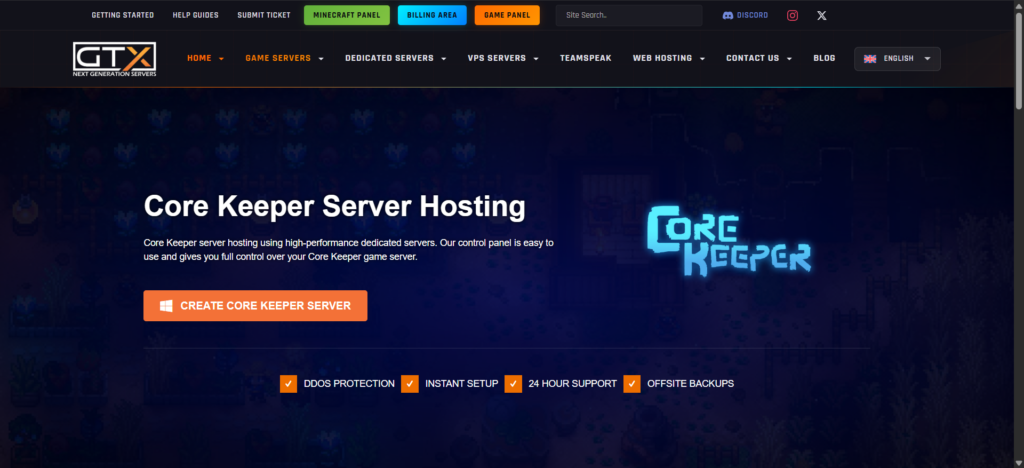
Price: Custom configurations start around £5.70/month (roughly $7.30), scaling with the RAM, cores, and slots you select.
GTXGaming has served the UK and European market since 2007, and Core Keeper hosting follows the same custom-configuration approach the company uses across its catalog. Hardware options run from a 2288G up to newer chips like the 13900K and 7950X3D, paired with NVMe storage, and setup typically finishes in under 60 seconds. The proprietary panel, built on a TCAdmin foundation, handles daily offsite backups automatically, and server locations span more than 20 regions worldwide.
The refund window is the tightest on this list at just 24 hours, which doesn’t leave much room to test a server with a full group before deciding. Pricing in GBP is also a minor extra step for anyone tracking costs from outside the UK or EU.
Pros:
- Latest-generation Ryzen and Intel hardware options
- Sub-60-second setup
- Daily offsite backups
- 20+ global server locations
- Fully configurable RAM, CPU, and slots
Cons:
- Just a 24-hour refund window.
- Custom configuration takes a bit more upfront knowledge than a flat plan
- GBP pricing adds a small conversion step for non-UK/EU customers
GTXGaming is the strongest option if your group is mostly in Europe or you specifically want the newest hardware and don’t mind deciding fast, since there’s no long trial period to fall back on.
Conclusion
Cybrancee tops this list for the same reason it usually does: the cheap tier isn’t a trap, the hardware is genuinely good, and the 90-day refund window gives you actual time to test the server with a real group instead of guessing off a product page.
The other four earn their spots for narrower reasons. BisectHosting is worth the higher price if you want database support or the flexibility to run other games from the same account. Shockbyte works for a small, budget-minded group as long as you size the RAM ahead of where the world is heading, not just where it starts. ZAP-Hosting and GTXGaming both suit players who want to configure their own specs rather than pick from a fixed menu, with ZAP leaning toward raw flexibility and GTXGaming toward premium hardware for a European audience.
Whichever host you land on, check the RAM your group actually needs against how long you plan to keep the world running, not just what the plan page promises on day one.
Happy digging!
If you think your business should be on our list, contact us.