



Garry’s Mod never really had a “point,” and that’s the whole reason it’s still packed almost twenty years after it shipped on the Source engine. Someone spins up a DarkRP server meaning to mess around for an hour, and by midnight there’s a functioning economy, a jobs list nobody remembers writing, and a prop-kill drama unfolding in chat that somehow matters more than it should. Trouble in Terrorist Town, Prop Hunt, sandbox builds that turn into physics experiments nobody planned, it’s still one of the most flexible multiplayer sandboxes around, and a lot of that flexibility depends entirely on the server it’s running on.
Hosting a GMod server off someone’s home PC works until it doesn’t. The moment a DarkRP save file needs to survive a power outage, or a TTT server wants to stay up while the host is at work, a dedicated box stops being optional. The harder part is finding a host that treats GMod as more than a Source-engine afterthought bolted onto a Minecraft or Rust product line.
GMod is lighter than a lot of modern games on paper, but it leans hard on a few specific things: Steam Workshop integration for addons and maps, MySQL support for gamemodes like DarkRP that lean on a real database instead of flat files, and single-thread CPU performance since the game’s tick, like a lot of older engines, doesn’t spread itself across cores. A host that gets those three things right ends up mattering more than one boasting about RAM you’ll never come close to using.
What to Look For in a GMod Host
The checklist here is short, but a couple of items matter more than they look like they should.
The must-haves:
Steam Workshop support. Most GMod communities run on addons, and a host that makes you manually download and FTP every model, map, and script pack is asking for an afternoon you don’t have. Look for a panel that lets you paste a Workshop collection ID and walk away.
MySQL databases included. DarkRP, some TTT variants, and most serious roleplay gamemodes want a real database the moment a server has more than a handful of regulars. A host that charges extra for this, or doesn’t offer it at all, is going to cause problems down the line.
Decent single-thread CPU speed. GMod’s server tick runs on one core regardless of how many the box has, so a host bragging about core count without mentioning clock speed isn’t necessarily helping you.
Gamemode and addon one-click installers. TTT, Prop Hunt, DarkRP, and the rest have become common enough that a host with a search-and-click installer saves real setup time over hand-rolling a gamemode from a GitHub repo.
FastDL or a comparable way to serve custom content. Large addon collections take forever to download through the game’s default method, and a host that supports FastDL out of the box keeps new players from giving up on the loading screen.
Nice to have:
An instance manager or game-swap option, handy if the group’s interest drifts from GMod to something else for a while.
Server locations spread out, which matters for a public server and barely at all for a handful of friends in the same city.
A support Discord, useful when a Lua error shows up at midnight, though it shouldn’t be the only place to get real help.
Pricing Comparison
| Hosting Provider | Starting Price | RAM / Slots (Entry Tier) | Best For |
|---|---|---|---|
 | $6.99/month | 4GB, unlimited slots | Best overall, unlimited slots and storage from the start |
 | $11.99/month | 4GB, roughly 12 to 16 players | Instance Manager, swapping between 100+ games |
 | $11.99/month | 16 slots | Budget-friendly, Workshop asset installers |
 | $10.00/month | 20 slots | MySQL included, deep TTT and DarkRP tooling |
 | ~£6.00/month (~$7.50) | 20 slots | UK/EU players, slot-based pricing |
1. Cybrancee
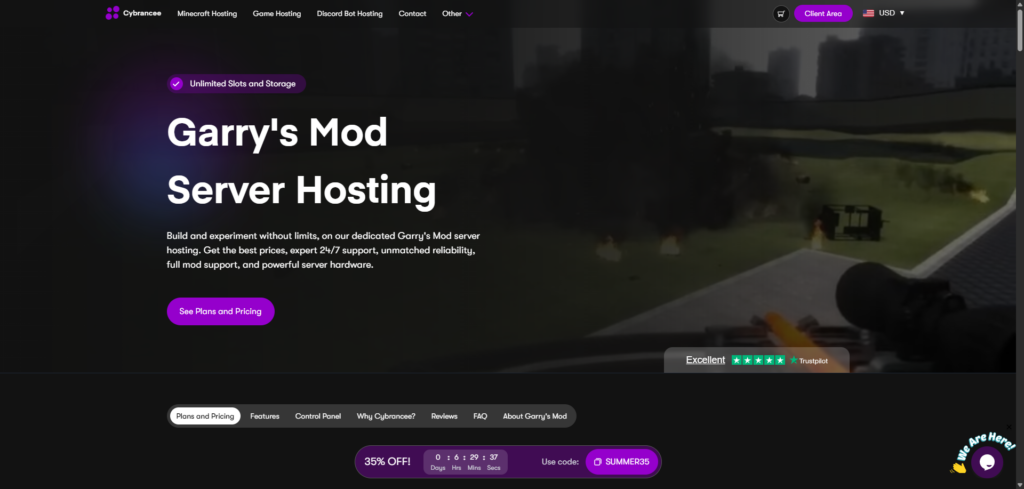
Cybrancee’s GMod plans start at $6.99/month for the Starter tier, and the whole pitch is the one it runs across its entire lineup: don’t gate the features people actually need behind a bigger plan. Unlimited player slots, unlimited bandwidth, and unlimited storage come standard on every tier, which matters more for GMod than it sounds since a busy DarkRP or sandbox server with a big addon collection eats disk space fast.
Steam Workshop integration is built into the panel, so collections install with a pasted ID instead of a folder of manually downloaded files, and MySQL databases are included rather than sold as an add-on, which is exactly where a DarkRP server tends to hit a wall on cheaper hosts. Hardware runs on Ryzen CPUs clocked above 4GHz with NVMe storage, a solid match for GMod’s single-thread tick. The panel is a customized build on Pterodactyl, a step up from the aging Multicraft interface a couple of hosts on this list are still running.
Pros:
- Unlimited slots, bandwidth, and storage on every plan
- Steam Workshop collections install by pasting an ID, no manual FTP work
- MySQL databases included, not an upsell
- Ryzen CPUs above 4GHz, NVMe storage
- One-click installers for TTT, Prop Hunt, DarkRP, and other common gamemodes
- Scheduled automatic backups with one-click restore
- Server locations across North America, Europe, UK, Asia, Australia, and India
- 90-day money-back guarantee, 24/7 human support plus an AI assistant for quick questions
Cons:
- New servers ship with a soft player-slot cap for performance reasons, raising it past the default takes a quick message to support rather than a self-serve toggle
- No free trial, though the 90-day refund window covers most of what a trial would anyway
For a DarkRP server that might outgrow its starting player count, or a sandbox build server that just needs room to grow, Cybrancee is the easiest recommendation here. The 90-day window means an actual community can take shape before deciding whether the host was the right call.
2. BisectHosting

Bisect has been in this space since 2011, and its GMod tooling runs through BisectOne, the same unified per-GB platform it uses across its whole 100-plus game catalog. A 4GB plan, enough for a small TTT or DarkRP server with a modest addon list, runs around $11.99/month, with 6GB and 12GB tiers available as a community grows.
The standout is the Instance Manager inside Bisect’s Starbase panel, which lets one account run several server setups at once and swap between them without ordering anything new, useful if a group’s interests bounce between GMod and something else some months. Steam Workshop collections install directly from the panel, and MySQL and MariaDB come standard, which matters for anything running a real DarkRP economy. Support tickets average under 15 minutes to a first response across 21 global locations, and DDoS protection is included free.
Pros:
- Instance Manager for running multiple server setups on one account
- Full Steam Workshop support through the panel
- MySQL and MariaDB included standard
- 21 global server locations
- Average support response under 15 minutes
- Free DDoS protection
Cons:
- Per-GB pricing climbs faster than Cybrancee’s flat tiers once a server grows past a small player count
- Only a 3-day money-back guarantee, a fraction of Cybrancee’s 90 days
- Backups are retained for 3 days, a short window if a bad addon update isn’t caught right away
If a group wants to hop between games or likes the idea of running more than one server setup off a single account, Bisect’s tooling earns its price. Just budget for the per-GB pricing once the community grows, and don’t expect much runway from the refund window.
3. Shockbyte
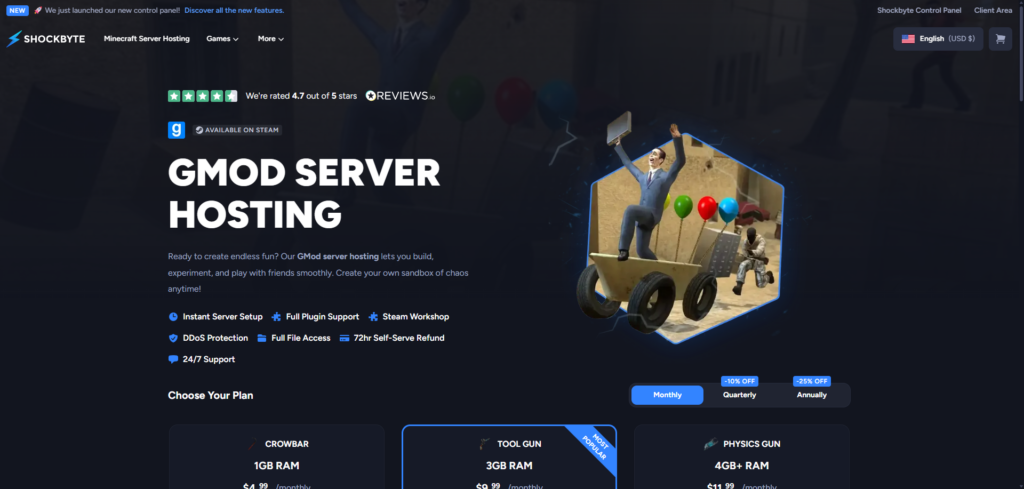
Shockbyte has spent over a decade building a reputation as the affordable, no-nonsense option, and GMod fits that pattern. A 16-slot plan runs around $11.99/month, aimed at a small TTT or Prop Hunt server without much overhead. Asset installers and Workshop integration are handled through the panel, so getting a gamemode and its addon collection running is a search-and-click job rather than a manual upload session.
The newer custom control panel replacing the old Multicraft setup is a genuine step up, with a more responsive console and addon browsing organized by category. Hardware runs on modern AMD EPYC processors, and instant setup means a server is playable within minutes of ordering.
The honest tradeoff is support speed, particularly around billing. Technical tickets tend to move at a reasonable pace, but billing issues have been reported taking anywhere from five to twelve days to resolve. The refund window sits at 3 days, and the optional hibernation feature that sleeps an idle server has been flagged by a few users as slow to wake back up.
Pros:
- Affordable entry point around $11.99/month for 16 slots
- Workshop and asset installers handled through the panel
- New custom control panel is a real step up over the old Multicraft interface
- Modern AMD EPYC hardware
- Free DDoS protection with an SLA covering network outages
Cons:
- Billing support response times are the slowest reported on this list, sometimes five to twelve days
- Only a 3-day (72-hour) refund window
- Hibernation mode can be slow waking a server back up after it’s gone idle
Shockbyte earns its spot as a legitimate budget pick for GMod. Just go in knowing a billing question might take a while to get answered.
4. HostHavoc
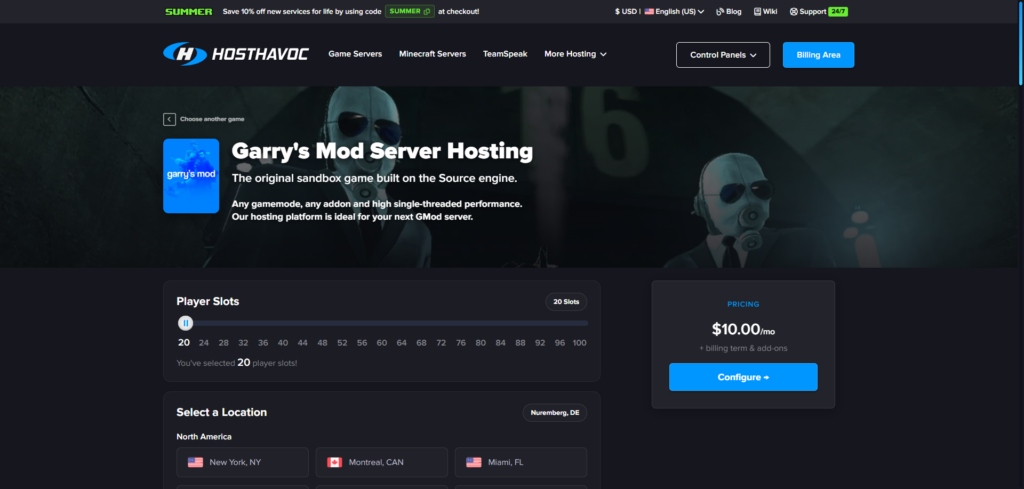
HostHavoc has built its name specifically around Source-engine games, and it shows in how deliberately the GMod tooling has been put together. Plans start at $10.00/month for 20 slots, scaling up to 100 slots for larger communities, and every plan includes MySQL databases standard, no upsell required for a DarkRP economy or a database-hungry gamemode.
The control panel handles one-click installers for common gamemodes like TTT, Prop Hunt, and Clone Wars, plus full Steam Workshop addon support. Power users get full FTP access and a file manager for anyone who’d rather manage content by hand. The panel itself runs on a modified TCAdmin build, and hardware leans toward high single-thread performance, which lines up with what GMod actually needs. Multi-tiered DDoS mitigation is included, and support tickets average under 10 minutes to a first response.
The tradeoffs are mostly about polish rather than substance. The TCAdmin panel is functional but doesn’t have the newer, cleaner look of Cybrancee’s or Bisect’s dashboards, and HostHavoc doesn’t publicly advertise a clear refund window the way Cybrancee or GTX Gaming do, so it’s worth checking directly before committing to a longer term.
Pros:
- MySQL databases included on every plan, no add-on required
- One-click installers for TTT, Prop Hunt, Clone Wars, and more
- Full Steam Workshop add-on support
- Full FTP access and file manager for hands-on management
- Average ticket response under 10 minutes
- Multi-tiered DDoS protection
Cons:
- TCAdmin panel is solid but starting to feel dated next to newer competitors
- No clearly advertised refund window
- 20-slot minimum on the entry plan is higher than some budget-focused competitors
If reliability and deep gamemode support matter more than having the newest-looking panel, HostHavoc is a safe, focused choice for a GMod community that plans to stick around.
5. GTX Gaming
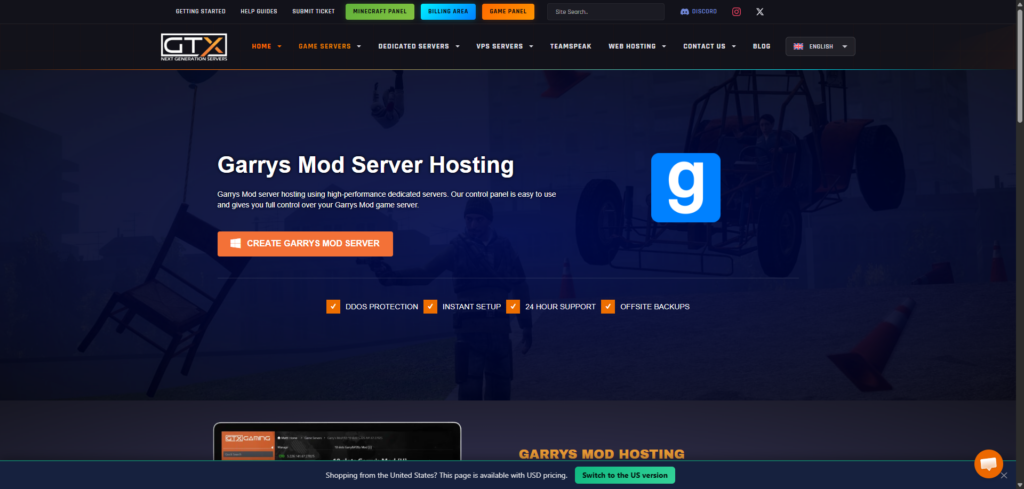
GTX Gaming has built a strong following in the UK and European market, and its GMod pricing reflects that: plans start from around £6.00/month (roughly $7.50) for a basic 20-slot server. Unlimited addons are supported on every tier, along with every map and gamemode combination a group would want to run, and hardware runs on the same enterprise-grade setup GTX uses across its lineup.
The control panel splits general management, Source-specific controls, and addon browsing across a few separate tools rather than one unified dashboard, which takes a minute to learn but leaves full FTP access available for anyone who wants it. Free DDoS protection, an offsite backup system, and live chat support are included on every plan, and deployment is essentially instant once payment clears.
The catch is the refund window. It’s 24 hours, the tightest on this list by a wide margin, which doesn’t leave much room to properly stress-test a server before deciding whether GTX is the right fit.
Pros:
- Budget-friendly entry price around £6.00/month
- Unlimited addons on every plan
- Enterprise hardware shared across GTX’s whole lineup
- Free DDoS protection and offsite backups
- Strong Trustpilot reputation around 4.6 to 4.7 out of 5
Cons:
- Just a 24-hour money-back guarantee, the shortest window on this list
- Pricing in GBP is a minor hassle for non-UK/EU customers tracking costs elsewhere
- Panel setup spans multiple tools rather than one unified interface
If the player base is mostly European, or a tight budget matters more than a long trial period, GTX Gaming covers ground the rest of this list doesn’t. Just decide quickly, because there’s no long refund window to fall back on.
Steam Workshop, FastDL, and Where GMod Addons Actually Live
Almost everything that makes a GMod server worth joining, gamemodes, maps, models, weapons, comes from the Steam Workshop. A host that lets a server owner paste a Workshop collection ID and have every addon in it download automatically saves real setup time over the old method of downloading each file by hand and uploading it through FTP.
Large addon collections still take a while to reach new players through Steam’s default download method, which is where FastDL comes in. It serves custom content from a separate web server instead of routing it all through the game connection, and it’s the difference between a new player joining in under a minute and one giving up on a loading bar that barely moves. Not every host supports it out of the box, so it’s worth checking before assuming a slow first-join experience is just how GMod works.
MySQL matters more here than it does for a lot of other games. DarkRP in particular leans on a database for anything beyond a handful of regulars, since flat-file storage falls over once a server has real player data to track. A host that includes MySQL standard, rather than treating it as a paid extra, saves a real headache once a community starts to grow.
Conclusion
Cybrancee tops this list because it doesn’t make Workshop support, MySQL, or basic slot limits something to pay extra for. Unlimited slots and storage from the $6.99 entry tier, Workshop collections that install with a pasted ID, and a 90-day window to actually run a community through its early growing pains puts it ahead for most people setting up a GMod server.
The other four earn their spots for narrower reasons. Bisect is worth it for the Instance Manager and the ability to swap between games from one account. Shockbyte is the pick for a tight budget, as long as billing tickets aren’t urgent. HostHavoc is the strongest choice for a DarkRP or TTT community that wants deep gamemode tooling and doesn’t mind an older-feeling panel. GTX Gaming makes the most sense for European players who want to move fast on price, given how little time that 24-hour refund window leaves to decide.
GMod is forgiving on hardware compared to most modern games, but Workshop handling and MySQL support are where a host either gets it right or leaves a community stuck troubleshooting things that should just work. Check what a specific gamemode actually needs before committing to a plan, not just what the pricing page claims is enough.
Happy tinkering!
If you think your business should be on our list, contact us.